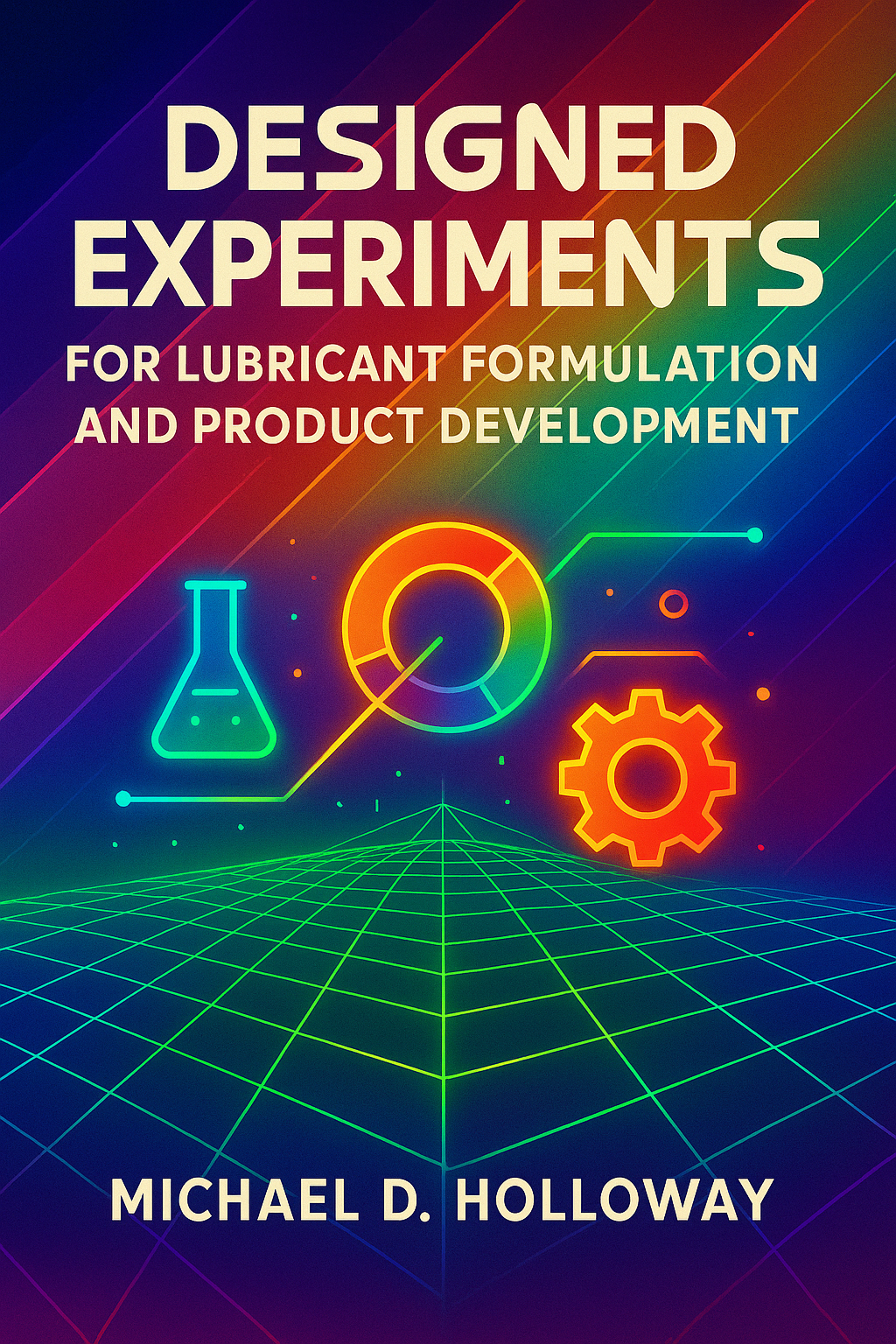
Designed Experiments for Lubricant Formulation and Product Development

$500.00

PDF Designed Experiments for Lubricant Formulation and Product Development by Michael D. Holloway provides a comprehensive guide to the application of statistical design of experiments (DoX) methodologies in the development, formulation, testing, and optimization of lubricants. As lubricants operate in complex and variable environments, their formulation requires the systematic study of interactions among base oils, additive packages, and process variables to ensure reliable performance across a range of conditions. This book empowers chemists, tribologists, engineers, and product developers with structured experimental approaches to reduce trial-and-error and accelerate time to market.

The book begins by defining the key types of variablesโ€”independent, dependent, categorical, control, random, interaction, and noiseโ€”and explains their roles in experimental design. It then guides the reader through foundational and advanced DoX methods, including factorial designs, response surface methodology (RSM), mixture designs, central composite designs (CCD), Taguchi orthogonal arrays, and robust parameter design (RPD). Each method is illustrated with lubricant-specific examples such as optimizing viscosity, wear resistance, oxidation stability, and performance under shear, load, and temperature extremes.


Real-world application is emphasized through case studies, showing how DoX enables formulation tuning, process optimization, and lifecycle integration, from screening base oil blends to validating field-ready performance under noisy, uncontrolled conditions. Practical experimental matrices, contour plots, and response surface models are used to identify optimal conditions and synergistic effects.

Designed for both seasoned professionals and emerging engineers, the book bridges formulation science with statistical engineering, offering a roadmap for developing high-performance, robust, and cost-effective lubricants. Its industrial relevance, structured approach, and extensive examples make it a vital resource for R&D professionals, quality assurance teams, and technical educators working in tribology, petrochemicals, and lubricant technology.
 

Description

๐‘ซ๐’†๐’”๐’Š๐’ˆ๐’ ๐’๐’‡ ๐‘ฌ๐’™๐’‘๐’†๐’“๐’Š๐’Ž๐’†๐’๐’•๐’” (๐‘ซ๐’๐‘ฟ) ๐’‡๐’๐’“ ๐‘ณ๐’–๐’ƒ๐’“๐’Š๐’„๐’‚๐’๐’•๐’”: ๐‘จ ๐‘ท๐’“๐’‚๐’„๐’•๐’Š๐’„๐’‚๐’ ๐‘ฎ๐’–๐’Š๐’…๐’† ๐’‡๐’๐’“ ๐‘ญ๐’๐’“๐’Ž๐’–๐’๐’‚๐’•๐’๐’“๐’”, ๐‘น๐’†๐’”๐’†๐’‚๐’“๐’„๐’‰๐’†๐’“๐’” & ๐‘น๐’†๐’๐’Š๐’‚๐’ƒ๐’Š๐’๐’Š๐’•๐’š ๐‘ฌ๐’๐’ˆ๐’Š๐’๐’†๐’†๐’“๐’”.Lubrication science is advancing faster than ever: new base stocks, additive chemistries, environmental pressures, electrification, and dramatically shifting performance demands. Yet most organizations still rely on intuition-driven formulation changes, one-factor trials, or legacy testing sequences that miss critical interactions.This book was written to change that. Grounded in applied statistics, industrial forensics, and more than 30 years of hands-on lubrication engineering, this work provides a step-by-step experimental framework for developing, optimizing, and validating lubricants across industrial, automotive, power-generation, and specialty applications.Readers will find guidance on:
  • Choosing the right DOE structure for lubricant development
  • Understanding formulation variables: base oils, viscosity modifiers, AW/EP additives, detergents/dispersants, antioxidants, esters, and more
  • Screening studies for rapid assessment of additive candidates โ€ข Interaction effects that drive wear, oxidation, and deposit behavior
  • How to statistically validate formulation performance
  • Designing field trials and long-term condition-monitoring studies
  • Using DOE to enhance EV fluids, turbine oils, hydraulic systems, and grease formulations
  • Building defensible, reproducible, data-centric R&D programs
This book is written not just for formulators, but for reliability engineers, lab managers, tribologists, and anyone responsible for improving lubrication performance through structured experimentation. As the industry moves toward more sustainable, efficient, and high-performance lubrication systems, rigorously designed experiments will define the winners. If you or your team want to elevate your lubrication R&D, product development, or field validation capabilities, this book provides the blueprint.